


Dye Bath in suitably large container
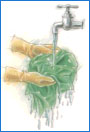
Rinse

Cold Water Dyes - Hand Dyeing
Having prepared the fabric and made up the dye bath, you are now ready to dye the article.
The dyeing process consists of two stages:
- dyeing the garment
- fixing the colour
Dyeing the garment
- Wet your fabric
- If your dye bath is not yet in the container you intend to use for the dyeing process, transfer the dye bath into a suitably large container (such as a pot)
- Immerse the wet article in the dye bath.
- Put the dye bath onto the stove and slowly heat it.
- The use of warmer water - up to 60°C - improves the shade further.
- Do not, however, heat the dye bath beyond 60°C.
- Move the fabric around continuously so the dye can penetrate all folds and creases (continual agitation helps to achieve an even distribution of heat, and thus colouration).
- Keep the garment fully submerged for the duration of the dyeing process, which should not be less than 20 minutes.
- Fixing the colour ensures that your article retains the shade you have chosen, and largely reduces colour running.
- Dissolve the fixative in 250ml boiling water.
- Lift the fabric and hold it above the DYE BATH while you add the fixative solution.
- Stir the solution into the dye bath, then replace the fabric.
- We recommend raising the temperature and keeping it at approximately 60°C during this phase, as it enhances the shade and levelness.
- Move the fabric around occasionally for a further 45 minutes.
- Rinse in cold water until the water runs clear.
- Warm wash with washing powder, re-rinse in cold water and dry.
When you have completed the dyeing process, you should wash the pot you used out after use with detergent and water.