

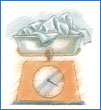
Weigh
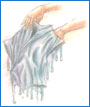
Wash

Before you get started, get prepared
Best be safe!
- Although our dyes are considered non-toxic, care should always be taken when handling chemicals.
- Avoid prolonged inhalation of dye powder which can cause an allergic reaction in some people.
- If you are concerned about the appearance of your hands, wear latex rubber gloves for protection from temporary skin staining.
- Dyeing is more a science than an art, so keeping to the instructions really does pay off... so please make sure that you have read and understood the instructions (either those that came with the product or those that appear on this website) BEFORE you begin.
- You might also want to to ensure that you have the right equipment, domestic accessories and available time.
Identify the fabric type before dyeing
Why identify the fabric type before dyeing?
- because natural fibres dye best - cotton providing the best results.
- Non-natural fabrics give mixed results...
- Poly-cotton mixtures give reduced shades and can yield "unlevel" (blotchy) results.
- Synthetic and acrylic fabric types cannot be successfully dyed in the home (these require very high temperature and pressure conditions).
- Silk can be dyed under particular conditions (you will have to use an acidic agent, such as vinegar)
- If you are intending to dye silk, please click here for special instructions
- We do not recommend any do-it-yourself dyes for use on wool; the relatively high temperatures required for home-use dyes cause wool to shrink and lose shape.
Weigh the fabric before dyeing it
Why weigh the fabric type before dyeing?
- because it determines how much dye you need to use.
- Each pack of Lady Dye fabric dye will dye 250g of fabric (weighed dry) to the shade indicated on the pack
- varying the proportion of dye to fabric weight makes for lighter or darker shades
- If you are going to dye something which weighs considerably less than 250g, the following formula will help you to establish exactly how much dye and water you will need to use:
- [ DRY WEIGHT OF THE ARTICLE (in grams) ]
x 0.08
= DYE required (amount in grams) - [ DRY WEIGHT OF THE ARTICLE (in grams) ]
x 20
= WATER required (amount in milliliters) - So, for example, if your article to be dyed weighs 100g when dry, you will require 100 x 0.08 = 8g of dye, and 100 x 20 = 2000ml of water
- [ DRY WEIGHT OF THE ARTICLE (in grams) ]
Prepare the fabric first
Why prepare the fabric before dyeing?
- Preparing the fabric is important because dyeing IS an exact science.
- Foreign or unexpected elements (such as starch, sizing, dirt and marks) present in the chemical reaction (i.e. the dyeing process) may affect the final result achieved. So make sure you remove any and all of these nasties before dyeing - the freer of impurities the article is, the better the result that can be expected.
- Cleanliness is next to Godliness.
- Remember what your mum told you about washing your hands before you eat? Well, it's the same here.
- Don't be lazy - ALL fabric must be washed, whether old or new...
- New fabric must be thoroughly washed to remove all starch and sizing.
- Old fabric must be washed to remove any dirt or marks.
- White is, um, right.
- Under optimum conditions, our dyes are expected to be used on white natural fabric - typically cotton. So the closer to white the article is, the better the result that can be expected.
- Previously dyed fabrics can be stripped of colour with Lady Dye Colour and Stain Remover, or a bleach and water solution.
- Remember, the ultimate shade is affected by the original fabric colour, so the closer to white the article is, the better. Even in South Africa.